Syllabus
Data Analytics for Professional Accountants
Course Overview
| Course Number | ACCTG 522 |
|---|---|
| Course Name | Data Analytics for Professional Accountants |
| Quarter | Autumn 2026 |
Why study Accounting Analytics?
Data analytics for professional accountants (accounting analytics) is a set of techniques that professional service firms can use to gain insight from their own, client, and other data to make better decisions. In combination with emerging technologies, the promise of data analytics has been described as the fourth industrial revolution. This means that data & analytics skills are becoming increasingly important and central for the provision of professional accounting services. In this course, students will benefit from the interest and promise of accounting analytics techniques by studying the analytical mindset. To further unlock the value of accounting analytics, students will design, perform, interpret, and communicate insight from raw data by developing a practical analytic skillset using multiple analytic software tools.
I am excited to undertake our accounting analytics journey together!
Asher
How this course fits into your education:
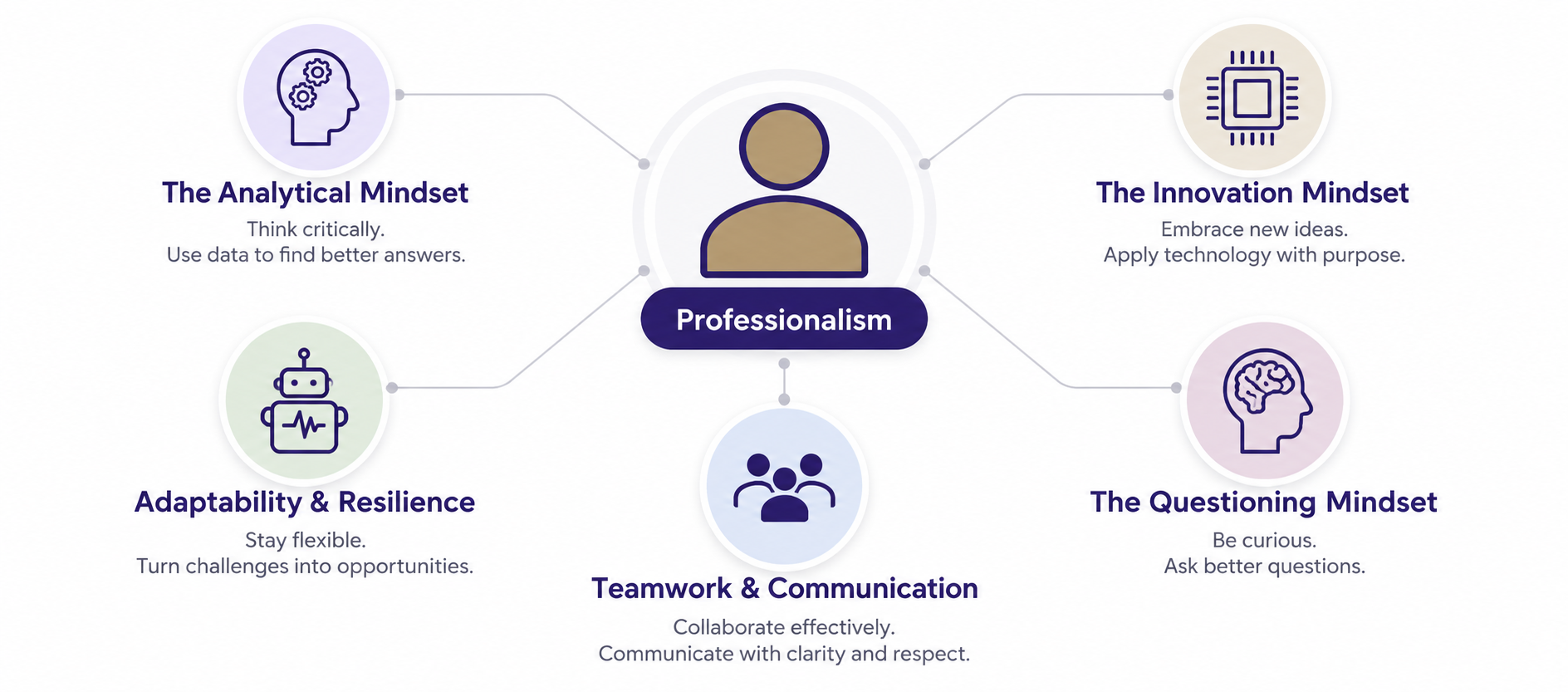
Advanced Cases in Assurance Services (ACCTG522) is a required course in the MPAcc and concentrates on the study of the analytical mindset through data-driven case studies in audit and assurance practices. Students will also enhance their adaptability and resilience mindset by examining different assurance settings and questions, using multiple software packages, and incorporating multiple data types and quality. Students will work in teams and communicate questions and conclusions drawn from data analytics, using verbal communication, written communication, and data visualization. Students will use the questioning and innovation mindsets when identifying the underlying purpose of assurance related services, areas for judgment, and areas of opportunity for integrating data analytics and other emerging technology. The skills and tools from Data Analytics for Professional Accountants (ACCTG522) will provide a foundation for data exercises in this class.
Learning Objectives
- Students will be able to design and perform Extract, Transform and Load (ETL) solutions: By cleaning raw data By merging multiple datasets together By automating data ingestion By extracting more complex data structures including XBRL and JSON
- Students will be able to design, perform, interpret, and communicate data analytics solutions: By computing visualizations for descriptive analysis By computing forecasts and predictive analytics By computing machine learning-based analytics By extracting more complex data structures including XBRL and JSON
- Students will become adaptable and resilient to changing data & analysis circumstances: By using multiple different software to solve problems By programming or using python code By working in diverse teams on unstructured problems By collecting financial and other data from public sources to support a large project
- Students will be able to identify and compare opportunities for the use of data analytics innovative settings: By examining potential uses of drone technology By examining potential uses of satellite technology By examining the use of process mining

Faculty Info

Grading Policies and Assignments
| Assignment | Format(s) | Weight |
|---|---|---|
| Professionalism | in-class polls, activities and verbal communication | 25% |
| Individual Case Submissions | video | 25% |
| Final Project Check-In Meeting | in-person meeting, written response | 10% |
| MPAcc Autumn Common Final Project | presentation and written materials | 40% |
Professionalism
An individual assessment of student professionalism throughout the quarter. Students are expected to maintain a professional approach to work and approach all classes as professional engagements. Part of this grade is determined via information collected via in-class polls, observation of class activities, and assessment of the quality of verbal communication.
Individual Case Submissions
Students will record a video to describe and present findings associated with a selected case. The goal is to demonstrate effective communication of the evidence that the data analysis supports and the limitations of the analysis performed.
Final Project Check-In Meeting
This meeting supports the common final project by having students meet with the instructor. The meeting will allow for student teams to discuss their progress and defend their current decisions. The questions raised by the instructor must be noted down and responded to via a memo that is submitted in a timely manner following the meeting. Note that meetings will be recorded by the instructor.
MPAcc Autumn Common Final Project
The Common Final Project is a team based presentation focusing on the use of real-time data to support financial statement analysis for the initiation of a pairs trading strategy (one long position and one short position) for two chosen public companies. Teams select how they will narrow their analysis to two firms through the use of a screening analysis and other preliminary analysis. The project is expected to draw on concepts from all courses. Teams will present in the Thursday MPAcc classes in the final week of the course. All teams are required to attend all presentations.
Course Calendar
| Session | Date | Topic |
|---|---|---|
| 1 | Introduction to the Analytics Mindset and Skillset | |
| 2 | Introduction to the Extract, Transform and Load (ETL) Process | |
| 3 | The ETL process: Extraction from APIs | |
| 4 | The ETL process: Relational Databases | |
| 5 | The ETL Process: Introduction to Transforming data | |
| 6 | The ETL Process: Advanced Data Transformations | |
| 7 | The ETL Process: Regular Expressions | |
| 8 | The ETL Process: Text Analytics | |
| 9 | Financial Screening and Signal Construction | |
| 10 | Data Veracity and Validation | |
| 11 | Financial Information as Data: 10-Ks and SEC Filings | |
| 12 | LLMs and Financial Information | |
| — | Veterans DayNo class | |
| 13 | Evaluating LLM Outputs and Building Evidence | |
| 14 | SEC Comment Letters and Regulatory Analytics | |
| 15 | Short Selling and Forensic Financial Analysis | |
| — | Thanksgiving BreakNo class | |
| 16 | Combining Structured and Unstructured Evidence | |
| 17 | Advanced Financial Analytics / Case Investigation | |
| 18 | From Analytics to Automated/Agentic Workflows | |
| 19 | Integration and Final Project Preparation | |
| — | Common Final Project Presentations Presentations occur during normal MPAcc class times and locations. |
Course Policies
Foster Integrity Principles
I will uphold the fundamental standards of honesty, respect, and integrity and I accept the responsibility to encourage others to adhere to these standards.
HONESTY: I will be truthful with myself and others.
RESPECT: I will show consideration for others and their ideas and work.
INTEGRITY: I will be a leader of character. I will be fair in all relations with others.
Access and Accommodations
Your experience in this class is important to me. If you have already established accommodations with Disability Resources for Students (DRS), please communicate your approved accommodations to me at your earliest convenience so we can discuss your needs in this course. If you have not yet established services through DRS, but have a temporary health condition or permanent disability that requires accommodations (conditions include but not limited to; mental health, attention-related, learning, vision, hearing, physical or health impacts), you are welcome to contact DRS at 206-543-8924 or uwdrs@uw.edu or disability.uw.edu. DRS offers resources and coordinates reasonable accommodations for students with disabilities and/or temporary health conditions. Reasonable accommodations are established through an interactive process between you, your instructor(s) and DRS. It is the policy and practice of the University of Washington to create inclusive and accessible learning environments consistent with federal and state law.
Religious Accommodations
Washington state law requires that UW develop a policy for accommodation of student absences or significant hardship due to reasons of faith or conscience, or for organized religious activities. The UW's policy, including more information about how to request an accommodation, is available at The UW's policy, including more information about how to request an accommodation, is available at Religious Accommodations Policy. Accommodations must be requested within the first two weeks of this course using the Religious Accommodations Request form.
AI
In all Foster courses, use of generative AI tools is permitted without disclosure as a learning and productivity tool, except on specific assignments or assessments where it may be prohibited, restricted, or required to ensure you build the foundational knowledge and skills your career will depend on. You are responsible for the accuracy, integrity, and originality of all individual and team submitted work. AI-generated content should be augmented with your substantial human judgment to meet the desired standards or learning objectives, and you should be able to explain and defend anything you submit to your instructor or teammates. See the Foster AI Syllabus Statement for full details and responsibilities. Use of AI in violation of assignment-specific guidelines constitutes academic misconduct under the UW Student Conduct Code (Academic Misconduct Policy).