Why study Accounting and Finance?
Business analytics is transforming how organizations understand and execute accounting and finance processes. In this course, we examine how data, automation, and artificial intelligence come together to move from insight generation to intelligent, scalable workflows.
Business Analytics for Accounting and Finance examines the evolving role of data, automation, and artificial intelligence in modern financial and accounting environments. The course investigates how organizations transition from data-driven insight generation to fully integrated automation systems, where processes are increasingly executed, monitored, and adapted by intelligent technologies rather than human intervention alone.
How this course fits into your education:
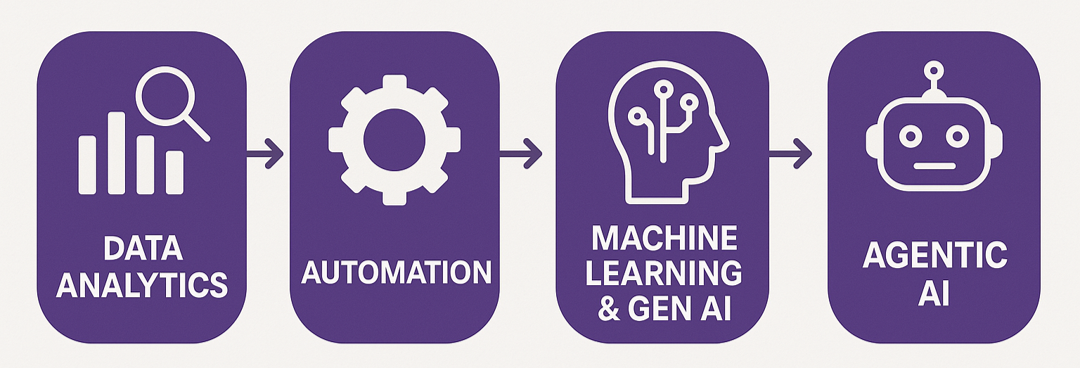
The course is structured around a progression from foundational analytics towards advanced automation. It begins with the use of visualization tools to interpret accounting and financial data and to identify decision-relevant patterns. It then develops students’ ability to structure and transform data within accounting information systems using self-service analytics tools, emphasizing repeatability, auditability, and data lineage. Building on this foundation, the course introduces task and enterprise automation through robotic process automation (RPA), framing automation not only as an efficiency mechanism but also as a layer of governance embedded within business processes.
Subsequent modules extend automation into more complex environments involving unstructured data and decision-making. Students examine intelligent document processing systems that extract and classify information from invoices, contracts, and other financial documents, and then progress to agentic automation frameworks in which workflows are dynamically managed based on goals, exceptions, and contextual inputs. The course further explores how open-source artificial intelligence models—including those for image, text, and voice processing—can be integrated into automation pipelines using Python, highlighting tradeoffs between enterprise platforms and modular, customizable architectures.
Key learning objectives:
- Students will be able to design, perform, interpret, and communicate data analytics solutions in accounting & finance settings:
- By computing visualizations for descriptive analysis
- By computing machine learning-based analytics
- By extracting more complex data structures
- Students will be able to propose and defend opportunities for the use of emerging technologies in data analytics and automation:
- By evaluating robotic process automation solutions.
- By evaluating Generative AI solutions.
- Students will be able to explain how technology can facilitate a combination of digital and physical solutions to complex advisory issues
- By evaluating Generative AI and other technologies to solve business problems.
- By evaluating the use of emerging technology to solve business problems.
- Students will be able to build and present a proof-of-concept intelligent or agentic automation solution to a business problem
- By researching and evaluating processes fit for intelligent or agentic automation.
- By implementing automation using RPA software.
- By implementing intelligent or agentic frameworks using LLMs within an automation solution.
Prerequisites, required texts, materials, and software:
- There are no other formal prerequisites for this course.
- There is no required text for this course. If you wish to explore a topic in greater depth, please ask your instructor for recommendations.
- Materials outlining the required deliverables, templates, sample code/solutions, background readings and/or cases are accessed via Canvas.
- Students will be using specialized software in this course all of which will be made available on the Foster remote labs, an open-source or cloud-based setting, or from a subscription.
Required Deliverables:
Assessment in this course is focused on providing you with feedback on how well you can undertake and communicate analysis in audit cases, with an increased weight on the use of data analytics. You will be assessed on both written and verbal communication as well as the ability to effectively work in your teams and as an individual. Deliverable submission portals and grades are all maintained on the class Canvas page. The deliverables page provides submission links. A summary of the components of the deliverables used to determine your grade are below, detail for each assessment follows:
| Assessment | Assessment Type | Deliverables | Due Date | Grade Percentage |
|---|---|---|---|---|
| Professionalism | Individual | Polls; Quizes; Learning check-ins;Verbal and Written Communication | All Quarter | 20% |
| RPA Individual Submission | Individual | Software; Short Video Recording | Following Class 3 | 30% |
| Intelligent Automation Team Challenge | Team | Software; Presentation | Class 7 | 50% |
Professionalism: An individual assessment of student professionalism throughout the quarter. Students are expected to maintain a professional approach to work and approach all classes as professional engagements. Part of this grade is determined via deliverables relating to pollEverywhere engagement, written responses and other deliverables to cases and verbal communication in class.
RPA Individual Submission: An individual project that includes building an RPA software solution that is explained, motivated and demonstrated in a recorded video presentation. Each individual will be asked to develop a desktop-level automation robot of a common repetitive business task. The bot is to be built using either UIPath or the Microsoft Power Apps. The RPA solution is expected to work on a single desktop, and any issues related to the transfer of the bot need to be identified and discussed. The automation solution needs to be motivated in terms of how many human work hours it can save (efficiency) and the value associated with reductions in human errors (effectiveness). Details and further guidance will be provided on Canvas.
Intelligent Automation Team Challenge: A team project that focuses on an enterprise level automation robot aimed at solving a reporting problem. The bot can be demonstrated in a proof-of-concept state which includes being presented on a single desktop, not relying upon live data inputs, not being 100% completed at the enterprise-level, and producing rudimentary dashboards or other outputs. Teams should consider how the solution can be considered as "Intelligent Automation" by applying Generative Artificial Intelligence and/or using Agentic AI / teams of AI Agents. The presentation of the automation solution will be focused on the technical goals (including clearly articulating the process using a process diagram) and limitations of the bot. Teams are recommended to discuss their solution from their instructor as early as possible for feedback on feasibility and expectations. Details and further guidance will be provided on Canvas.
Administrative Matters:
|
Instructor: |
Asher Curtis, PhD. Herbert O. Whitten Endowed Associate Professor of Accounting. |
|
Class Times: |
See Course Schedule for Details |
|
Location: |
PACCAR 291 |
|
Office Hours: |
By appointment |
Religious Accommodations:
Washington state law requires that UW develop a policy for accommodation of student absences or significant hardship due to reasons of faith or conscience, or for organized religious activities. The UW’s policy, including more information about how to request an accommodation, is available at Religious Accommodations Policy. Accommodations must be requested within the first two weeks of this course using the Religious Accommodations Request form.
Policies and Further Questions:
Questions about the content of this course should first be directed to the instructor. Please see https://registrar.washington.edu/staffandfaculty/syllabi-guidelines/ for important university policy and guidelines.
Generative AI Policy
This policy outlines expectations for the responsible and ethical use of generative AI technologies, including large language models (LLMs) such as ChatGPT, in this course. These tools can significantly enhance learning, productivity, and creativity–but must be used transparently and professionally to support a respectful and effective learning environment.
Permitted Use:
Generative AI may be used to assist with idea generation, research, document drafting, programming, editing, and other academic work, provided the output is critically reviewed, refined, and understood by the student or team. Use of AI is encouraged when it enhances the learning process.
Student Responsibility:
Students are responsible for the accuracy, relevance, and integrity of any work submitted, including content influenced or generated by AI tools. Errors introduced by generative AI–factual, analytical, or interpretive–will be treated as student errors and may result in reduced grades.
Disclosure & Ethics:
Students may be asked to disclose when and how they used generative AI tools in individual or team assignments. In cases where the use of AI significantly contributes to the submission (e.g., coding assistance, text drafting), students should include a brief statement describing the use.
Unacceptable Use:
Submitting AI–generated content without understanding it, using AI to bypass individual learning (e.g., for comprehension–based quizzes or in–class polls), or allowing AI to make up sources or misrepresent work is a violation of course expectations and academic integrity.
This policy may be updated as the role of AI in education continues to evolve.
Tentative Course Schedule
| Class | Date | Topic |
|---|---|---|
| Class 1 | Thursday, April 2, 2026 | Introduction to Accounting and Finance Analytics |
| Class 2 | Thursday, April 9, 2026 | Data Analytics Workflows in Accounting and Finance |
| Class 3 | Thursday, April 16, 2026 | Robotic Process Automation, Part 1 |
| Class 4 | Thursday, April 23, 2026 | Robotic Process Automation, Part 2 |
| Class 5 | Thursday, May 7, 2026 | Agentic Automation |
| Class 6 | Thursday, May 21, 2026 | Open Source AI Models for Automation Workflows and Final Project Workshop |
| Class 7 | Saturday, May 30, 2026 | Course Conclusion and Intelligent Automation Team Challenge Presentations |