Responses remain in page memory and are not submitted to the instructor. Refreshing or closing clears your work. Answers in this practice page are inspectable.
Navigator: ○ unanswered · ✓ answered · ⚑ marked for review. Short and extended answers use self-assessment, not automatic grading.
Fairview · Extended answer
Cost-neutral for whom?
Fairview is evaluating a fixed reimbursement per trip. The table describes
all trips during the review period.
Trips during the review period
Employee
Trips
Current reimbursement per trip
A
24
$5
B
12
$15
C
4
$25
Management proposes setting a fixed payment that preserves total
reimbursements for these same trips.
After calculating that payment, management adds two requirements:
- Employees who gain under the fixed payment retain their gains.
- Employees who lose receive top-ups restoring their original total
reimbursements.
The revised process would reduce administration costs by $60 during the
same review period. Assume no other costs change.
Management states:
"Most trips benefit from the new payment. Because the fixed payment is
cost-neutral and nobody will lose, the revised policy improves fairness
without increasing company cost."
Required:
a. Calculate the initially cost-neutral fixed payment and each employee's
reimbursement change before top-ups.
b. Calculate the percentage of trips and percentage of employees receiving
more before top-ups. Explain why the percentages differ.
c. Calculate the final change in reimbursements and combined company cost
after top-ups and administration savings.
d. Evaluate management's statement and identify one additional consideration
needed before recommending adoption.
Use concise paragraphs and show calculations. Address all four parts. Equivalent defensible reasoning is acceptable.
Expected difficulty: Challenging
This is an instructor estimate, not a measure of your ability.
Suggested answer
Current reimbursements total 24 × $5 + 12 × $15 + 4 × $25 = $400 across
40 trips. The initially cost-neutral payment is therefore $10 per trip.
Before top-ups, A gains $120, B loses $60, and C loses $60. Twenty-four of
40 trips receive more, or 60%, but only one of three employees receives
more overall, approximately 33.3%. The percentages differ because the
employee taking the most trips counts once in the employee calculation
but contributes many observations to the trip calculation.
Restoring B's and C's losses adds $120 to the initially neutral proposal.
Final reimbursements are $520, an increase of $120. After the $60
administration saving, combined company cost increases by $60.
Management correctly states that most trips benefit and that the initial
fixed payment is reimbursement-neutral. However, the revised policy
increases company cost. Preventing losses also does not establish fairness
under every reasonable criterion: employees receive different gains, and
fairness requires an explicit objective. Before adoption, management
should consider issues such as future trip composition, reliability of
administration savings, incentives, or the complexity of ongoing top-ups.
Equivalent wording and other defensible reasoning can be acceptable. Compare your reasoning; this is self-assessment, not an instructor grade.
Common errors
Averaging the three reimbursement rates without weighting by trip counts.
Reporting the percentage of trips as the percentage of employees.
Assuming the policy remains neutral after restoring losses.
Treating "nobody loses" as sufficient evidence of fairness.
Fairfield · Extended answer
Does testing every transaction make the conclusion reliable?
Following the Fairfield analysis, the head of Internal Audit states:
“Previously, we examined only a sample. The bot now checks every trip leg, so we can treat the difference between reported and validated mileage as the amount improperly reimbursed. Further verification would duplicate work already completed.”
Required:
a. Explain what examining the complete population improves and what it does not establish.
b. Explain why the bot’s distance may differ from legitimate mileage actually traveled.
c. Describe the verification you would require before reporting improper reimbursements to the Audit Committee.
Use concise paragraphs. Address all three parts and support your reasoning with the scenario. No calculations are required. Equivalent defensible reasoning is acceptable.
Expected difficulty: Challenging
This is an instructor estimate, not a measure of your ability.
Suggested answer
Examining every recorded trip leg improves coverage and allows patterns to be identified across employees and offices. It does not establish that the underlying records are complete, that the bot interpreted addresses correctly, or that its distance represents the route actually traveled.
Differences could arise from alternative routes, road closures, necessary business stops, address errors, or inconsistent treatment of trip legs. These possibilities do not establish that claims are legitimate; they demonstrate why a discrepancy requires interpretation.
Before reporting improper reimbursements, I would reconcile the tested population to reimbursement records, inspect the bot’s handling of addresses and unsuccessful lookups, and compare selected outputs with independent checks. I would also examine relevant policy and supporting trip documentation. The report should distinguish identified mileage differences, unresolved exceptions, and corroborated policy violations. A full-population comparison strengthens coverage but does not eliminate measurement error or the need for judgment.
Equivalent wording and other defensible reasoning can be acceptable. Compare your reasoning; this is self-assessment, not an instructor grade.
Common errors
Assuming that testing every record makes the measurement or interpretation correct.
Treating the mapping-service distance as direct evidence of the route actually traveled.
Fairfield · Extended answer
From detecting exceptions to improving the process
After reviewing the Fairfield findings, management proposes automatically rejecting every future mileage claim that exceeds the mapping service’s distance. Management argues that this will prevent overpayments and eliminate the need for employees to explain discrepancies.
Required:
Recommend whether management should adopt this proposal unchanged, modify it, or reject it. Support your recommendation by addressing:
a. The trade-off between preventing improper payments and rejecting legitimate claims.
b. A practical process for handling exceptions.
c. How management should evaluate whether the revised process is working.
Use concise paragraphs. Address all three parts and support your reasoning with the scenario. No calculations are required. Equivalent defensible reasoning is acceptable.
Expected difficulty: Challenging
This is an instructor estimate, not a measure of your ability.
Suggested answer
I would modify the proposal. A mapping-service distance is a useful reference, but treating it as an exact limit assumes it captures all legitimate travel circumstances. Automatic rejection could discourage unsupported claims while also denying valid reimbursements and creating disputes or incentives to report the benchmark rather than actual travel.
A better process would use the reference distance to flag claims for proportionate review. Employees should be able to document legitimate deviations, with approval by an appropriate reviewer and a record of the explanation. Repeated patterns and higher-risk exceptions could receive additional scrutiny. Management should also clarify route, rounding, and documentation expectations so employees understand the policy.
Evaluation should consider corroborated improper payments, legitimate claims initially flagged, review workload, reimbursement delays, and recurring causes of exceptions. A decline in flagged claims alone would not demonstrate success: employees might have changed reporting behavior, or the process might have stopped detecting problems. Other recommendations can be defensible when supported by explicit assumptions, safeguards, and a reasoned evaluation of consequences.
Equivalent wording and other defensible reasoning can be acceptable. Compare your reasoning; this is self-assessment, not an instructor grade.
Common errors
Treating fewer exceptions as sufficient evidence that the underlying problem has been resolved.
Recommending automatic rejection without considering legitimate deviations or a review process.
Analytical mindset · Multiple choice
A manager asks an analyst to use customer data to improve the business. Which response best establishes a useful starting point?
Expected difficulty: Moderate
This is an instructor estimate, not a measure of your ability.
Correct answer: B
A defined decision establishes which evidence and analysis are relevant.
A: Begins calculations without a purpose.
C: Begins with the tool rather than the decision.
D: Begins preparation without establishing relevance.
Analytical mindset · Multiple choice
An organization repeatedly uses a budget forecast containing an unnoticed spreadsheet error. Which procedure most directly helps detect the error before reliance?
Expected difficulty: Moderate
This is an instructor estimate, not a measure of your ability.
Correct answer: D
Reconciliation and formula testing directly address input and calculation errors.
A: A common template can repeat the same error.
B: More frequent circulation does not validate the numbers.
C: A dashboard can display an incorrect forecast accurately.
Analytical mindset · Multiple choice
An airline finds that premium seats generate more revenue per seat than economy seats. Which additional analysis best supports replacing some economy seats?
Expected difficulty: Moderate–challenging
This is an instructor estimate, not a measure of your ability.
Correct answer: B
The decision requires incremental revenues, costs, and the alternative use of space.
A: Existing totals do not evaluate the proposed change.
C: Price alone omits demand and costs.
D: The existing mix does not establish the change’s value.
Analytical mindset · Multiple choice
A chart shows customer complaints increased. Management must decide whether to invest in employee training. Which addition most strengthens the recommendation?
Expected difficulty: Moderate
This is an instructor estimate, not a measure of your ability.
Correct answer: C
Communication should connect evidence with the decision and its limits.
A: A display change does not strengthen the inference.
B: Detail alone does not explain the decision.
D: Removing uncertainty can mislead the decision maker.
Analytical mindset · Multiple choice
Premium-cabin revenue increased after an airline added lounge benefits. Which conclusion is best supported by that observation alone?
Expected difficulty: Moderate
This is an instructor estimate, not a measure of your ability.
Correct answer: D
The observation does not isolate a cause or establish profitability.
A: Other factors could explain the increase.
B: The evidence does not establish value on all routes.
C: Revenue alone omits incremental costs.
Analytical mindset · Multiple choice
An airline wants to compare two uses of limited aircraft space. Which dataset is most useful for evaluating the financial trade-off?
Expected difficulty: Moderate
This is an instructor estimate, not a measure of your ability.
Correct answer: A
Comparable expected revenues and costs under each alternative address the decision.
B: A maximum price does not measure expected contribution.
C: Preferences alone do not establish purchases or costs.
D: Aircraft sizes alone do not quantify the alternatives.
Data quality · Multiple choice
Removing a file extension stops the expected application opening on double-click. Which conclusion is most appropriate?
Expected difficulty: Foundational
This is an instructor estimate, not a measure of your ability.
Correct answer: C
Renaming need not change file contents.
A: Names and stored data are distinct.
B: An appropriate reader may still interpret the original bytes.
D: An extension does not determine the representation.
Data quality · Multiple choice
A semicolon-delimited file opens with each entire row in one Excel cell. What should the analyst do first?
Expected difficulty: Moderate
This is an instructor estimate, not a measure of your ability.
Correct answer: A
Correct import options recover the intended field structure.
B: Opening does not establish correct interpretation.
C: Deleting delimiters destroys useful structure.
D: Renaming does not convert the contents.
Data quality · Multiple choice
Cash is recorded as 20500 M for one company and 900 K for another. Documentation defines M as millions and K as thousands. An analyst removes the letters and compares 20500 with 900. What is wrong?
Expected difficulty: Moderate
This is an instructor estimate, not a measure of your ability.
Correct answer: D
Convert to a common unit before comparing amounts.
A: Comparisons are possible after appropriate preparation.
B: Units and identifiers are different issues.
C: Documented values can be interpreted.
Data quality · Multiple choice
Inventory includes zeros and dashes. The meaning of a dash is unknown. What is most defensible?
Expected difficulty: Moderate
This is an instructor estimate, not a measure of your ability.
Correct answer: B
Treatment depends on the source meaning.
A: A dash need not mean zero.
C: Deletion is unjustified without investigation.
D: Imputation introduces an unsupported estimate.
Data quality · Multiple choice
An analyst sums JobsReported in PPP loan records and calls the total jobs that would have disappeared without PPP. What is the strongest objection?
Expected difficulty: Moderate–challenging
This is an instructor estimate, not a measure of your ability.
Correct answer: C
The field alone does not identify a counterfactual outcome.
A: Cleaning does not supply the counterfactual.
B: A data-type conversion does not resolve measurement.
D: Grouping does not establish causal impact.
Data quality · Multiple choice
Demographic information is missing for many PPP records. Category A represents 40% of records with reported demographics. What is supported?
Expected difficulty: Moderate–challenging
This is an instructor estimate, not a measure of your ability.
Correct answer: A
The observed denominator excludes missing demographic records.
B: Size does not resolve selective missingness.
C: Missingness may be nonrandom.
D: Observed proportions do not classify missing records.
Data quality · Multiple choice
Small business is defined by an annual revenue threshold, but available data contain loan amounts and industry codes, not revenue. What is best?
Expected difficulty: Moderate
This is an instructor estimate, not a measure of your ability.
Correct answer: D
The measure required by the definition is absent.
A: Loan size is an unvalidated substitute for revenue.
B: Standardization does not create revenue data.
C: Loan amounts and revenue are different variables.
Data quality · Multiple choice
An analyst converts equivalent date representations to a common format and validates them before placing the data in an analytical database. Which activity is transformation?
Expected difficulty: Foundational
This is an instructor estimate, not a measure of your ability.
Correct answer: B
Standardization and validation are transformation activities.
A: Downloading is extraction.
C: Placement in the destination is loading.
D: A recommendation is a later analytical decision.
Combining data · Multiple choice
Financial and market datasets list the same companies in different orders. How should information be associated?
Expected difficulty: Foundational
This is an instructor estimate, not a measure of your ability.
Correct answer: C
Keys identify the entity regardless of row position.
A: Position does not establish identity.
B: Magnitude does not identify the company.
D: Position is not a matching rule.
Combining data · Multiple choice
A physical join must retain all journal-entry line items, including those without preparer information. Which join meets that objective?
Expected difficulty: Moderate
This is an instructor estimate, not a measure of your ability.
Correct answer: A
A left join retains all left-side line items.
B: Inner joins exclude unmatched line items.
C: That preserves the wrong population.
D: Removing unmatched line items violates the objective.
Combining data · Multiple choice
Preparer 101 identifies different employees in two business units. An analyst matches using PreparerID alone. What is the main risk?
Expected difficulty: Moderate
This is an instructor estimate, not a measure of your ability.
Correct answer: D
The identifier alone does not distinguish employees across units.
A: Joining does not automatically aggregate rows.
B: Incomplete keys need not cause exclusion.
C: Software may accept an analytically wrong join.
Combining data · Multiple choice
Each business-unit/preparer pair occurs once in PreparerInfo and can occur many times in line items. What relationship is expected from PreparerInfo to line items?
Expected difficulty: Moderate
This is an instructor estimate, not a measure of your ability.
Correct answer: B
One reference record can describe multiple line items.
A: A preparer can have multiple line items.
C: Keys are unique on the reference side.
D: Repeating on the many side is expected.
Combining data · Multiple choice
A table has 100 line items. Exactly one matches two preparer records; all others match exactly one. How many rows result from a physical left join?
Expected difficulty: Moderate–challenging
This is an instructor estimate, not a measure of your ability.
Correct answer: C
One duplicated match adds one output row.
A: An extra match does not remove a row.
B: Left joins can increase row count.
D: Only one line item has two matches.
Combining data · Multiple choice
After a correct composite-key left join, some line items have no matching preparer reference record. What is supported?
Expected difficulty: Moderate
This is an instructor estimate, not a measure of your ability.
Correct answer: A
The join establishes a reference-data gap.
B: Authorization cannot be inferred from a missing match.
C: An unexplained item is not necessarily invalid.
D: An inner join hides the records rather than supplying information.
Combining data · Multiple choice
An account ID is text 00120 in one table and number 120 in another. What should the analyst do before matching?
Expected difficulty: Moderate
This is an instructor estimate, not a measure of your ability.
Correct answer: D
Meaningful representation must be established before changing IDs.
A: Appearance alone does not standardize values.
B: Zeros may carry meaning.
C: Different representations can refer to the same account.
Combining data · Multiple choice
A business-unit/preparer key should be unique in a reference table, but the model detects many-to-many cardinality. What is the most useful first check?
Expected difficulty: Moderate
This is an instructor estimate, not a measure of your ability.
Correct answer: B
The unexpected repetition must be investigated on the intended one side.
A: Changing a setting does not correct underlying keys.
C: Amount size does not diagnose reference-key uniqueness.
D: Loading does not validate relationships.
Transforming fields · Multiple choice
An extraction takes the first three characters as location. A new file has two- and four-character locations. What is most likely?
Expected difficulty: Moderate
This is an instructor estimate, not a measure of your ability.
Correct answer: C
A positional rule can execute even when its structural assumption fails.
A: Substring operations need not reject changed formats.
B: Counts do not validate component boundaries.
D: Type conversion does not identify boundaries.
Transforming fields · Multiple choice
Documentation confirms M and Mo both mean monthly pay. How should employee counts by pay frequency treat them?
Expected difficulty: Moderate
This is an instructor estimate, not a measure of your ability.
Correct answer: A
Equivalent meanings should be represented consistently.
B: Different strings can share one meaning.
C: Mo is documented as valid.
D: Normalization should not duplicate employees.
Transforming fields · Multiple choice
Why retain EmployeeCode after extracting location, employee ID, plant ID, and pay period?
Expected difficulty: Moderate
This is an instructor estimate, not a measure of your ability.
Correct answer: D
The original field supports traceable validation.
A: Retention enables checking but does not prove accuracy.
B: Corrections may still be needed.
C: Transformation rules still require documentation.
Transforming fields · Multiple choice
Plant 12 exists in both USA and CAN. Which key distinguishes the plants if plant IDs are unique within locations?
Expected difficulty: Moderate
This is an instructor estimate, not a measure of your ability.
Correct answer: B
The pair identifies a plant under the stated uniqueness rule.
A: Plant IDs repeat across locations.
C: A location can contain multiple plants.
D: Employee names do not identify plants.
Transforming fields · Multiple choice
A variable-format extraction is correct for the first employee record and preserves the total number of rows. What is the best next check?
Expected difficulty: Moderate
This is an instructor estimate, not a measure of your ability.
Correct answer: C
Validation should cover the formats on which the rules depend.
A: One record and row retention are insufficient.
B: Sorting does not test extraction.
D: Some identifiers and categories should remain text.
Repeatable exception testing · Multiple choice
Employee pay frequency is Mo and the plant requires Monthly. Documentation says these are equivalent. What should happen before flagging an exception?
Expected difficulty: Moderate
This is an instructor estimate, not a measure of your ability.
Correct answer: A
Semantic equivalence must be standardized before comparison.
B: A representation difference is not a substantive mismatch.
C: Changing all requirements is unjustified.
D: The record is interpretable and should not be removed.
Repeatable exception testing · Multiple choice
After validated preparation and matching, an employee’s recorded frequency is Weekly while the plant reference says Monthly. What does the flag establish?
Expected difficulty: Moderate
This is an instructor estimate, not a measure of your ability.
Correct answer: D
The test identifies a recorded discrepancy, not its cause or payment consequence.
A: Amounts and actual payments have not been established.
B: Intent is not observed.
C: Either source or its applicability could need review.
Repeatable exception testing · Multiple choice
Why reuse a documented Power Query workflow for next month’s data?
Expected difficulty: Moderate
This is an instructor estimate, not a measure of your ability.
Correct answer: B
Repeatability reduces repeated work but does not eliminate validation.
A: Source structures and meanings may change.
C: Reference matches still need checking.
D: Execution and analytical correctness are distinct.
Repeatable exception testing · Multiple choice
After a left join, some employees have no matching plant requirement. How should the exception summary treat them?
Expected difficulty: Moderate
This is an instructor estimate, not a measure of your ability.
Correct answer: C
Unknown expected frequency is a different issue from an observed mismatch.
A: No requirement is available to establish mismatch.
B: No requirement is available to establish compliance.
D: Exclusion hides the completeness problem.
Fairfield · Multiple choice
Four claims have reported/validated mile pairs 24.2/14.2, 31.7/21.7, 18.5/8.5, and 42.0/32.0. Which finding is supported?
Expected difficulty: Moderate
This is an instructor estimate, not a measure of your ability.
Correct answer: B
Every signed difference is positive ten miles.
A: Intent needs additional evidence.
C: Validation does not by itself establish actual travel.
D: All four differences have the same direction.
Fairfield · Multiple choice
One employee’s claim differences are +12 and −12 miles. Another’s are +2 and +2 miles. What does the first employee’s zero net difference establish?
Expected difficulty: Moderate
This is an instructor estimate, not a measure of your ability.
Correct answer: D
Netting can conceal individual discrepancies.
A: Each claim has a nonzero difference.
B: Policy compliance requires more information.
C: Zero net does not eliminate claim-level issues.
Fairfield · Multiple choice
Reported mileage frequently ends in a whole mile, while validated mileage often has tenths. What follow-up most directly evaluates whether the pattern reflects acceptable reporting?
Expected difficulty: Moderate
This is an instructor estimate, not a measure of your ability.
Correct answer: A
Policy and signed differences address permissibility and direction.
B: Whole-mile reporting alone does not establish intent.
C: Deleting records does not investigate the pattern.
D: Digit concentration alone does not establish upward direction.
Fairfield · Multiple choice
Selected claims involve another employee’s location. Which response is most defensible?
Expected difficulty: Moderate
This is an instructor estimate, not a measure of your ability.
Correct answer: C
The relationship identifies a targeted question requiring corroborating evidence.
A: A relationship alone does not prove collusion.
B: Business visits may be legitimate.
D: Aggregate totals can conceal relevant relationships.
Fairview · Multiple choice
There are 100 trips: 80 reimburse $5 each and 20 reimburse $20 each under the current policy. Which fixed payment preserves total reimbursements for these same trips?
Expected difficulty: Moderate–challenging
This is an instructor estimate, not a measure of your ability.
Correct answer: D
Current payments are 80×5 + 20×20 = $800; $800/100 = $8.
A: That covers only the lower-cost trips.
B: The simple average of two amounts ignores trip counts.
C: That covers only the higher-cost trips.
Fairview · Multiple choice
A has 70 trips receiving more under a fixed payment. B, C, and D each have ten trips receiving less. Each employee’s total change follows that direction. What share of employees receives more overall?
Expected difficulty: Moderate
This is an instructor estimate, not a measure of your ability.
Correct answer: A
One of four employees gains, although 70 of 100 trips gain.
B: 70% is the trip share.
C: 30% is the share of trips receiving less.
D: 75% is the share of employees receiving less.
Fairview · Multiple choice
A fixed-payment proposal has reimbursement changes of +$600, −$450, and −$150 across three employees. The company restores both losses while retaining the $600 gain. What is the change in total reimbursement relative to the original policy?
Expected difficulty: Moderate
This is an instructor estimate, not a measure of your ability.
Correct answer: C
The neutral proposal plus $600 in restored losses costs $600 more.
A: Restoring losses removes the original offset.
B: Restoration raises rather than lowers payments.
D: The gain is already included in the neutral proposal.
Fairview · Multiple choice
Policy A has $24,000 projected reimbursements and $500 administration cost. Policy B has $24,400 reimbursements and $900 administration cost. Current administration cost is unknown. Which statement is supported?
Expected difficulty: Moderate
This is an instructor estimate, not a measure of your ability.
Correct answer: B
A totals $24,500 and B totals $25,300; the difference is $800.
A: Unknown current administration prevents this conclusion.
C: That ignores the $400 administration difference.
D: The supplied amounts permit a comparison of listed costs.
Analytical mindset · Short answer
A manager asks you to create a dashboard to improve customer profitability. Before building it, identify two questions you would ask and explain why the answers matter.
Answer in approximately 3–5 sentences. Show calculations where requested; concise equivalent reasoning is acceptable.
Expected difficulty: Moderate
This is an instructor estimate, not a measure of your ability.
Suggested answer
I would ask what decision the manager intends to make and how customer profitability will be defined. The decision determines which comparisons are relevant, while the definition establishes the revenues, costs, and unit of analysis needed. These choices should guide the dashboard rather than follow from the available software.
Equivalent wording and other defensible reasoning can be acceptable. Compare your reasoning; this is self-assessment, not an instructor grade.
Common errors
Listing chart types without establishing the decision.
Analytical mindset · Short answer
Customer complaints fell after a company introduced employee training. Explain why this observation alone does not establish that the training caused the decline, and identify one useful follow-up analysis.
Answer in approximately 3–5 sentences. Show calculations where requested; concise equivalent reasoning is acceptable.
Expected difficulty: Moderate
This is an instructor estimate, not a measure of your ability.
Suggested answer
The before-and-after pattern is consistent with a training effect, but other changes could explain it, including customer volume, product quality, or complaint reporting. I would examine complaints relative to customer activity and compare trends across otherwise comparable trained and untrained groups, while considering how employees were selected for training. Such comparisons strengthen the evidence but do not automatically establish causation.
Equivalent wording and other defensible reasoning can be acceptable. Compare your reasoning; this is self-assessment, not an instructor grade.
Common errors
Treating a decline after training as proof that training worked.
Analytical mindset · Short answer
An airline proposes replacing six economy seats with two premium seats. Identify the additional information needed to assess the financial effect and explain why higher premium revenue per seat is insufficient.
Answer in approximately 3–5 sentences. Show calculations where requested; concise equivalent reasoning is acceptable.
Expected difficulty: Moderate
This is an instructor estimate, not a measure of your ability.
Suggested answer
The airline needs expected occupancy and fares under each configuration, conversion costs, relevant service costs, and the economy revenue or contribution displaced. The relevant comparison is the change in expected revenues less the change in relevant costs, including the alternative use of the space. Higher premium revenue per seat alone does not establish a higher total contribution.
Equivalent wording and other defensible reasoning can be acceptable. Compare your reasoning; this is self-assessment, not an instructor grade.
Common errors
Comparing ticket prices while ignoring seats displaced and demand.
Data quality · Short answer
A semicolon-delimited file opens with every row in one spreadsheet cell. Explain the likely problem and describe two checks you would perform after correcting the import.
Answer in approximately 3–5 sentences. Show calculations where requested; concise equivalent reasoning is acceptable.
Expected difficulty: Moderate
This is an instructor estimate, not a measure of your ability.
Suggested answer
The reader likely used the wrong delimiter. I would import with a semicolon delimiter, respecting quoted fields, then compare column headings and selected records with the source. I would also check row counts and field types, particularly dates and identifiers with leading zeros. A successful import does not by itself establish correct interpretation.
Equivalent wording and other defensible reasoning can be acceptable. Compare your reasoning; this is self-assessment, not an instructor grade.
Common errors
Renaming the file or deleting delimiters as a conversion method.
Data quality · Short answer
A dataset contains 1,000 loan records. Demographic information is reported for 600 records, of which 240 belong to Category A. What can you report about Category A, and what limitation should accompany the result?
Answer in approximately 3–5 sentences. Show calculations where requested; concise equivalent reasoning is acceptable.
Expected difficulty: Moderate
This is an instructor estimate, not a measure of your ability.
Suggested answer
Category A represents 40% of the 600 records with reported demographics and is observed in 24% of all 1,000 records. Its true share across all records cannot be determined because the category membership of 400 records is unknown. Generalizing the 40% to all records would require an additional assumption about missing information.
Equivalent wording and other defensible reasoning can be acceptable. Compare your reasoning; this is self-assessment, not an instructor grade.
Common errors
Reporting 40% of all recipients without qualifying the missing information.
Data quality · Short answer
Company A reports cash as 2.5 M and Company B reports cash as 900 K. Documentation defines M as millions and K as thousands. A third company reports a dash with no definition. Explain how you would prepare these values for comparison.
Answer in approximately 3–5 sentences. Show calculations where requested; concise equivalent reasoning is acceptable.
Expected difficulty: Moderate
This is an instructor estimate, not a measure of your ability.
Suggested answer
I would convert the known amounts to a common unit: 2,500,000 and 900,000, or 2,500 and 900 in thousands. I would retain the original representations and document the conversion. I would preserve the dash as an unresolved value and investigate its meaning rather than assume it is zero.
Equivalent wording and other defensible reasoning can be acceptable. Compare your reasoning; this is self-assessment, not an instructor grade.
Common errors
Removing M and K and comparing 2.5 with 900 directly.
Combining data · Short answer
A table contains 120 journal-entry lines. Five lines have no matching preparer record. All remaining lines match exactly one preparer record. Explain the row counts expected from an inner join and a left join with journal-entry lines on the left. Which better supports reviewing the complete population?
Answer in approximately 3–5 sentences. Show calculations where requested; concise equivalent reasoning is acceptable.
Expected difficulty: Moderate
This is an instructor estimate, not a measure of your ability.
Suggested answer
The inner join returns 115 rows because it excludes the five unmatched lines. The left join returns 120 rows, retaining those lines with missing preparer information. The left join better supports a complete-population review, provided the unmatched lines are separately identified and investigated.
Equivalent wording and other defensible reasoning can be acceptable. Compare your reasoning; this is self-assessment, not an instructor grade.
Common errors
Assuming an inner join resolves missing preparer information.
Combining data · Short answer
Before a physical left join, an expense table has 100 rows totaling $10,000. Every expense matches one reference row except a $200 expense that matches two. Predict the resulting row count and expense total, and explain how you would investigate.
Answer in approximately 3–5 sentences. Show calculations where requested; concise equivalent reasoning is acceptable.
Expected difficulty: Moderate
This is an instructor estimate, not a measure of your ability.
Suggested answer
The join produces 101 rows and a total of $10,200 because the $200 expense appears twice. I would inspect repeated reference keys and confirm whether the intended key requires another field. I would then correct the key or reference data according to their meaning and reconcile the result to the original population.
Equivalent wording and other defensible reasoning can be acceptable. Compare your reasoning; this is self-assessment, not an instructor grade.
Common errors
Deleting a repeated output row without investigating the reference key.
Combining data · Short answer
PreparerID 101 identifies one employee in business unit East and another in business unit West. Explain why joining on PreparerID alone is unreliable and describe the conditions under which a composite key would address the problem.
Answer in approximately 3–5 sentences. Show calculations where requested; concise equivalent reasoning is acceptable.
Expected difficulty: Moderate
This is an instructor estimate, not a measure of your ability.
Suggested answer
PreparerID alone can match an entry to the wrong employee or to both employees. BusinessUnit and PreparerID together would distinguish the employees if each pair identifies exactly one relevant reference record. Both tables must use consistent business-unit and preparer conventions, and the reference pairs should be checked for uniqueness.
Equivalent wording and other defensible reasoning can be acceptable. Compare your reasoning; this is self-assessment, not an instructor grade.
Common errors
Assuming every repeated ID is an error rather than checking its scope.
Transforming fields · Short answer
An employee-code extraction takes the first three characters as Location. New valid codes include US-104-12-M and CAN-208-14-Mo, where hyphens delimit the fields. Explain the failure and propose a more defensible extraction and validation approach.
Answer in approximately 3–5 sentences. Show calculations where requested; concise equivalent reasoning is acceptable.
Expected difficulty: Moderate
This is an instructor estimate, not a measure of your ability.
Suggested answer
Taking three characters produces US- for the first location and CAN for the second, so the fixed-length assumption fails. Given the documented delimiters, I would split on hyphens and validate the expected four fields. I would compare extracted values with source codes across location lengths and pay-period forms and retain the original code for investigation.
Equivalent wording and other defensible reasoning can be acceptable. Compare your reasoning; this is self-assessment, not an instructor grade.
Common errors
Accepting the extraction because it runs without an error.
Transforming fields · Short answer
Documentation confirms that M, Mo, and Monthly all mean monthly pay. Explain how you would prepare these values for counting employees by pay frequency without losing the ability to audit your changes.
Answer in approximately 3–5 sentences. Show calculations where requested; concise equivalent reasoning is acceptable.
Expected difficulty: Moderate
This is an instructor estimate, not a measure of your ability.
Suggested answer
I would preserve the original pay-frequency field and create a standardized field using a documented mapping of M, Mo, and Monthly to Monthly. I would count using that standardized field and identify unmapped values for review. I would reconcile employee counts before and after the transformation to check for losses or duplication.
Equivalent wording and other defensible reasoning can be acceptable. Compare your reasoning; this is self-assessment, not an instructor grade.
Common errors
Combining similar-looking values without confirming equivalent meanings.
Transforming fields · Short answer
A transformation preserves all 500 source rows and correctly extracts fields from the first row. Explain why this is insufficient evidence of accuracy and propose two further checks.
Answer in approximately 3–5 sentences. Show calculations where requested; concise equivalent reasoning is acceptable.
Expected difficulty: Moderate
This is an instructor estimate, not a measure of your ability.
Suggested answer
Preserved row counts support completeness but do not establish that each field was extracted correctly. A correct first row does not test other formats. I would compare extracted fields to source codes across different locations, identifier lengths, and pay-period forms, and check required fields and allowed values while investigating exceptions.
Equivalent wording and other defensible reasoning can be acceptable. Compare your reasoning; this is self-assessment, not an instructor grade.
Common errors
Treating matching row counts as proof that all extracted fields are accurate.
Repeatable exception testing · Short answer
After documented standardization and validated matching, an employee is recorded as Weekly while the applicable plant reference says Monthly. Explain what the exception establishes, what it does not establish, and your next step.
Answer in approximately 3–5 sentences. Show calculations where requested; concise equivalent reasoning is acceptable.
Expected difficulty: Moderate
This is an instructor estimate, not a measure of your ability.
Suggested answer
The exception establishes that the recorded employee frequency differs from the applicable reference requirement. It does not establish that an incorrect payment occurred or that anyone acted intentionally. I would verify the effective dates and approved employee arrangements, inspect the supporting payroll records, and determine whether an actual payment consequence exists.
Equivalent wording and other defensible reasoning can be acceptable. Compare your reasoning; this is self-assessment, not an instructor grade.
Common errors
Labeling the employee overpaid or fraudulent based solely on the flag.
Repeatable exception testing · Short answer
A review of 200 employees identifies 12 frequency mismatches among employees with valid reference matches and eight employees with no matching plant requirement. Assuming the groups do not overlap, explain how you would summarize the results.
Answer in approximately 3–5 sentences. Show calculations where requested; concise equivalent reasoning is acceptable.
Expected difficulty: Moderate
This is an instructor estimate, not a measure of your ability.
Suggested answer
I would report 12 confirmed recorded-frequency mismatches, eight missing-reference records for which compliance could not be assessed, and 180 matched records without a frequency mismatch. I would investigate the two exception categories separately. The eight unknown cases should not be classified as either compliant or confirmed frequency mismatches.
Equivalent wording and other defensible reasoning can be acceptable. Compare your reasoning; this is self-assessment, not an instructor grade.
Common errors
Reporting all 20 as confirmed mismatches or treating the eight as compliant.
Repeatable exception testing · Short answer
A documented workflow ran successfully last month and runs without errors on this month’s payroll file. Identify three checks needed before relying on this month’s exception report and explain why successful execution is insufficient.
Answer in approximately 3–5 sentences. Show calculations where requested; concise equivalent reasoning is acceptable.
Expected difficulty: Moderate
This is an instructor estimate, not a measure of your ability.
Suggested answer
I would check whether the source schema and code meanings changed, reconcile the input and output populations, and inspect reference-match completeness and unexpected duplicate keys. I would also examine unusual changes in exception counts where relevant. Successful execution shows that the instructions ran; it does not show that their assumptions still hold or that the report is analytically correct.
Equivalent wording and other defensible reasoning can be acceptable. Compare your reasoning; this is self-assessment, not an instructor grade.
Common errors
Assuming a repeatable workflow eliminates the need to validate new data.
Fairfield · Short answer
An employee’s reported-minus-validated mileage differences are +15, -15, +5, and -5 miles. Calculate the net discrepancy and total absolute discrepancy. Explain what each measure reveals and one limit on your conclusion.
Answer in approximately 3–5 sentences. Show calculations where requested; concise equivalent reasoning is acceptable.
Expected difficulty: Moderate
This is an instructor estimate, not a measure of your ability.
Suggested answer
The net discrepancy is zero miles, while the total absolute discrepancy is 40 miles. The net measure shows the signed differences offset; the absolute measure shows the combined magnitude of claim-level differences. Neither measure alone establishes fraud or proves the validated distances were the routes actually traveled, so individual claims and supporting evidence require review.
Equivalent wording and other defensible reasoning can be acceptable. Compare your reasoning; this is self-assessment, not an instructor grade.
Common errors
Concluding that zero net mileage means every claim is accurate.
Fairfield · Short answer
Reported mileage often ends in whole miles, while validated mileage includes tenths. Explain why this pattern warrants investigation but does not establish improper reporting. Describe an appropriate follow-up.
Answer in approximately 3–5 sentences. Show calculations where requested; concise equivalent reasoning is acceptable.
Expected difficulty: Moderate
This is an instructor estimate, not a measure of your ability.
Suggested answer
The pattern could reflect an allowed rounding convention rather than improper reporting. Whole-mile concentration alone does not establish the direction of differences or intent. I would review the policy, calculate signed differences for individual claims, and compare the pattern with what the permitted rule would produce, checking supporting records for unexplained departures.
Equivalent wording and other defensible reasoning can be acceptable. Compare your reasoning; this is self-assessment, not an instructor grade.
Common errors
Treating every whole-mile claim as evidence of fraud.
Fairfield · Short answer
Two employees submit reimbursement claims for travel to each other’s home addresses. Explain the analytical finding, identify at least two pieces of corroborating evidence you would seek, and state a defensible preliminary conclusion.
Answer in approximately 3–5 sentences. Show calculations where requested; concise equivalent reasoning is acceptable.
Expected difficulty: Moderate
This is an instructor estimate, not a measure of your ability.
Suggested answer
The claims reveal reciprocal travel involving employee home addresses, which warrants targeted review of business purpose. I would seek itineraries or meeting records, approval documentation, applicable reimbursement policy, and confirmation that address classifications are correct. The relationship identifies a potential exception; without corroborating evidence it does not establish personal travel or collusion.
Equivalent wording and other defensible reasoning can be acceptable. Compare your reasoning; this is self-assessment, not an instructor grade.
Common errors
Inferring collusion directly from the relationship between addresses.
Fairview · Short answer
Under the current policy, 60 trips receive $6 each and 40 trips receive $16 each. Calculate a fixed payment per trip that preserves total reimbursements for these same 100 trips. Explain why the simple average of $6 and $16 is inappropriate.
Answer in approximately 3–5 sentences. Show calculations where requested; concise equivalent reasoning is acceptable.
Expected difficulty: Moderate
This is an instructor estimate, not a measure of your ability.
Suggested answer
Current reimbursements total 60 × $6 + 40 × $16 = $1,000. Dividing by 100 trips gives a cost-neutral fixed payment of $10 per trip. The simple average is $11 and implicitly gives the two trip groups equal weight despite their different counts. The $10 result applies to the specified trips and does not guarantee neutrality if future trip composition changes.
Equivalent wording and other defensible reasoning can be acceptable. Compare your reasoning; this is self-assessment, not an instructor grade.
Common errors
Using $11 by averaging two payment amounts without trip weights.
Fairview · Short answer
One employee takes 70 trips and gains $2 per trip under a proposal. Three other employees each take ten trips and lose $4 per trip. Calculate the share of trips receiving more, the share of employees receiving more overall, and the total reimbursement change. Explain why these measures differ.
Answer in approximately 3–5 sentences. Show calculations where requested; concise equivalent reasoning is acceptable.
Expected difficulty: Moderate
This is an instructor estimate, not a measure of your ability.
Suggested answer
Seventy of 100 trips receive more, so the trip share is 70%. One of four employees gains overall, so the employee share is 25%. The total change is 70 × $2 - 30 × $4 = +$20. The percentages differ because the frequent traveler accounts for many trips but only one employee; neither percentage alone determines the dollar effect.
Equivalent wording and other defensible reasoning can be acceptable. Compare your reasoning; this is self-assessment, not an instructor grade.
Common errors
Using the trip share as the share of employees who benefit.
Fairview · Short answer
A proposal changes reimbursements by +$500, -$300, and -$200 across three employees. Management then restores both losses while preserving the gain. The revised process also reduces annual administration cost by $250. Calculate the change in reimbursements and combined company cost relative to the original policy, assuming all figures cover the same year and no other costs change.
Answer in approximately 3–5 sentences. Show calculations where requested; concise equivalent reasoning is acceptable.
Expected difficulty: Moderate
This is an instructor estimate, not a measure of your ability.
Suggested answer
The initial proposal is reimbursement-neutral because the three changes sum to zero. Restoring $500 of losses makes reimbursements $500 higher than under the original policy. After the $250 administration saving, combined company cost increases by $250. Reimbursement neutrality and total-cost neutrality therefore require separate evaluation.
Equivalent wording and other defensible reasoning can be acceptable. Compare your reasoning; this is self-assessment, not an instructor grade.
Common errors
Calling the revised policy cost-neutral because the initial proposal summed to zero.
Analytical mindset · Short answer
A dashboard shows that Branch A has twice as many customer complaints as Branch B. A manager recommends replacing Branch A’s supervisor. Explain why complaint counts alone are insufficient and identify two additional pieces of information that would help evaluate the recommendation.
Answer in approximately 3–5 sentences. Concise equivalent reasoning is acceptable.
Expected difficulty: Moderate
This is an instructor estimate, not a measure of your ability.
Suggested answer
Complaint counts do not account for differences in customer volume or the nature of the complaints. I would compare complaint rates using an appropriate activity measure and investigate complaint severity and causes. Staffing, product mix, and changes over time may also matter. Even a higher complaint rate would not by itself establish that the supervisor caused the problem or that replacement is the best response.
Equivalent wording and other defensible reasoning can be acceptable. Compare your reasoning; this is self-assessment, not an instructor grade.
Common errors
Treating a larger complaint count as proof of worse management without considering activity levels or causes.
Data quality · Short answer
A loan dataset contains two records with the same business name and street address but different loan identifiers and approval dates. An analyst proposes deleting one record as a duplicate. Explain why this decision requires further investigation and describe an appropriate check.
Answer in approximately 3–5 sentences. Concise equivalent reasoning is acceptable.
Expected difficulty: Moderate
This is an instructor estimate, not a measure of your ability.
Suggested answer
Matching names and addresses do not establish that the records describe the same loan. They may represent separate loans to the same business, or they may reflect a data error. I would establish the dataset’s unit of observation, review the definitions and uniqueness of the loan identifiers, and inspect source documentation. A deletion rule should distinguish duplicate representations of one loan from legitimate multiple loans.
Equivalent wording and other defensible reasoning can be acceptable. Compare your reasoning; this is self-assessment, not an instructor grade.
Common errors
Assuming that repeated business names necessarily identify duplicate loans.
Combining data · Short answer
An analyst left joins journal-entry lines to a preparer reference table so that unmatched entries remain available for review. The analyst then filters the result to keep only records where the reference-table Department equals Accounting. Explain what happens to unmatched entries and how you would preserve them while identifying Accounting entries.
Answer in approximately 3–5 sentences. No software-specific syntax is required.
Expected difficulty: Moderate
This is an instructor estimate, not a measure of your ability.
Suggested answer
Unmatched entries have no reference-table department value, so a filter requiring Department to equal Accounting removes them. The left join initially preserved them, but the later filter defeats that completeness objective. I would retain the full joined result and create separate flags or views for Accounting matches and unmatched entries. This allows targeted review without losing the unmatched population.
Equivalent wording and other defensible reasoning can be acceptable. Compare your reasoning; this is self-assessment, not an instructor grade.
Common errors
Assuming that selecting a left join guarantees unmatched records remain after all later transformations.
Transforming fields · Short answer
An employee code contains employee identifier 0074. A transformation converts the identifier to the number 74. The reference table stores identifiers as four-character text. Explain the potential matching problem and describe how you would determine the appropriate correction.
Answer in approximately 3–5 sentences. Concise equivalent reasoning is acceptable.
Expected difficulty: Moderate
This is an instructor estimate, not a measure of your ability.
Suggested answer
The transformation removed leading zeros and changed the identifier’s representation, which may prevent a match with text 0074. I would confirm whether the documented convention requires four-character identifiers and whether 74 and 0074 identify the same employee. If confirmed, I would standardize to four-character text, preserve the source value, and validate matches and key uniqueness. I would not assume that removing or adding zeros is always appropriate.
Equivalent wording and other defensible reasoning can be acceptable. Compare your reasoning; this is self-assessment, not an instructor grade.
Common errors
Converting every identifier to a number without checking whether leading zeros are meaningful.
Repeatable exception testing · Short answer
A payroll workflow reported 18 frequency mismatches last month and zero this month. This month’s file contains a new pay-frequency label, Fortnightly, which the workflow does not recognize. Explain why zero exceptions may be misleading and describe two checks you would perform.
Answer in approximately 3–5 sentences. Concise equivalent reasoning is acceptable.
Expected difficulty: Moderate
This is an instructor estimate, not a measure of your ability.
Suggested answer
Zero reported mismatches may reflect an incomplete test rather than the resolution of all discrepancies. Depending on the workflow, unrecognized values could become missing values, be excluded, or fail to receive an exception flag. I would inspect the treatment and count of unmapped frequency values and reconcile all employees into matched, mismatched, and unassessed categories. I would confirm the new label’s meaning before updating the mapping and rerunning the test.
Equivalent wording and other defensible reasoning can be acceptable. Compare your reasoning; this is self-assessment, not an instructor grade.
Common errors
Interpreting zero exceptions as proof of compliance without checking test coverage.
Fairfield · Short answer
Employee A has two reported-minus-validated mileage differences of +20 and -20 miles. Employee B has two differences of +3 and +3 miles. Calculate each employee’s net discrepancy and total absolute discrepancy. Explain why these results do not establish a single obvious investigation priority.
Answer in approximately 3–5 sentences. Show calculations where useful.
Expected difficulty: Moderate
This is an instructor estimate, not a measure of your ability.
Suggested answer
Employee A has a zero net discrepancy and 40 miles of total absolute discrepancy. Employee B has a net discrepancy of +6 miles and six miles of total absolute discrepancy. A has larger claim-level differences, while B’s reported distances exceed validation on both claims. Priority depends on the review objective, applicable policy, reimbursement effects, and available supporting evidence; neither summary alone establishes intent.
Equivalent wording and other defensible reasoning can be acceptable. Compare your reasoning; this is self-assessment, not an instructor grade.
Common errors
Automatically dismissing Employee A because the net discrepancy is zero.
Fairview · Short answer
A fixed reimbursement of $10 per trip was cost-neutral for a historical population. Next year, the company expects 50 trips that would receive $8 each under the original policy and 30 trips that would receive $18 each. Calculate the projected reimbursement difference if the company retains the $10 fixed payment. What fixed payment would be cost-neutral for the projected trips?
Answer in approximately 3–5 sentences. Show calculations.
Expected difficulty: Moderate
This is an instructor estimate, not a measure of your ability.
Suggested answer
The original policy would reimburse 50 × $8 + 30 × $18 = $940 for the projected 80 trips. A $10 fixed payment would reimburse $800, which is $140 less than the original policy. A payment of $940 / 80 = $11.75 per trip would preserve projected total reimbursements. Historical cost neutrality does not guarantee future neutrality when trip composition changes.
Equivalent wording and other defensible reasoning can be acceptable. Compare your reasoning; this is self-assessment, not an instructor grade.
Common errors
Assuming the historically cost-neutral $10 payment remains neutral for a different trip population.
Combining data · Visual short answer
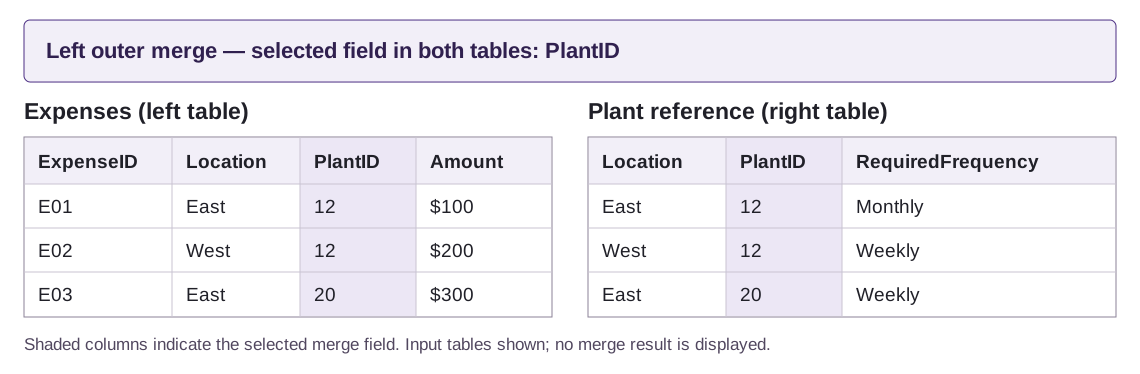
The exhibit shows expense records, a plant reference table, and a proposed Power Query merge using PlantID alone. Predict the row count and total Amount after the left outer merge. Explain the cause of the result and identify the fields that should be used instead.
Proposed merge and input tables.Complete text description of exhibit 1
Proposed merge: Left outer merge — selected field in both tables: PlantID.
Expenses (left table)
Columns: ExpenseID | Location | PlantID | Amount
E01 | East | 12 | $100
E02 | West | 12 | $200
E03 | East | 20 | $300
Plant reference (right table)
Columns: Location | PlantID | RequiredFrequency
East | 12 | Monthly
West | 12 | Weekly
East | 20 | Weekly
PlantID is the selected merge field in each input table. No merge result is shown.
Answer in approximately 3–5 sentences. Show calculations where requested; concise equivalent reasoning is acceptable.
Expected difficulty: Moderate
This is an instructor estimate, not a measure of your ability.
Suggested answer
The merge produces five rows totaling $900. Each expense with PlantID 12 matches both reference records for that plant number, duplicating the $100 and $200 amounts. Location and PlantID together identify the appropriate plant reference record, assuming each pair is unique. Using both fields produces three rows totaling $600. The repeated plant numbers are valid across locations; the proposed merge key does not distinguish those locations.
Equivalent wording and other defensible reasoning can be acceptable. Compare your reasoning; this is self-assessment, not an instructor grade.
Common errors
Deleting legitimate reference records instead of correcting the merge key.